The IELTS Speaking test is an 11–14 minute conversation with an examiner in three parts: short questions about yourself (Part 1), a 1–2 minute talk on a cue card (Part 2), and a discussion of broader ideas (Part 3). It’s scored on fluency and coherence, vocabulary, grammar and pronunciation, each worth a quarter of your band.
Below you’ll find real-style questions for each part, sample answers at roughly Band 7–8, and notes on why each answer works. Please don’t memorise them. Examiners hear memorised answers every day, and they’re trained to spot them.
How the Speaking test works
| Part | Time | What happens |
|---|---|---|
| Part 1: Introduction and interview | 4–5 minutes | The examiner asks about familiar topics: your work or studies, home, hobbies, daily routine |
| Part 2: Long turn | 3–4 minutes | You get a cue card, one minute to prepare, then speak for up to two minutes |
| Part 3: Discussion | 4–5 minutes | Deeper, more abstract questions linked to your Part 2 topic |
The Speaking test is the same for IELTS Academic and IELTS General Training. (If you’re not sure which test you need, read our guide to Academic vs General Training.)
For official practice material, the IELTS sample test questions page from the test owners is the best free source.
What examiners actually score
Four criteria, equal weight:
- 1Fluency and coherence. Can you keep talking without long pauses, and do your ideas connect logically?
- 2Lexical resource. Do you have the words to talk about the topic precisely, including less common vocabulary and natural phrases?
- 3Grammatical range and accuracy. Do you use a mix of simple and complex sentences, and are most of them correct?
- 4Pronunciation. Can the examiner understand you easily? Your accent isn’t the issue. Clarity, stress and intonation are.
Here’s what surprises most students: being interesting doesn’t earn marks. You can give a fairly ordinary answer and score Band 8 if the language is flexible and accurate. And you can say something brilliant in broken sentences and score 5.5. The content is just the vehicle.
Part 1 questions and sample answers
Part 1 is warm-up conversation. Aim for two to four sentences per answer. Too short sounds nervous; too long and the examiner has to interrupt you.
Q: Do you work or are you a student?
I’m working at the moment. I’m a junior accountant at a mid-sized firm in Parramatta, so most of my day is spent reconciling accounts and chasing up invoices. It’s not glamorous, but I like that there’s a right answer at the end of it.
Why it works: direct answer first, then a detail, then a personal opinion. “Chasing up invoices” is natural, specific vocabulary.
Q: Do you like cooking?
I only really started cooking properly when I moved to Sydney, because eating out every night gets expensive fast. Now I actually enjoy it, especially on Sundays when I’ve got time to try something new. My dal still doesn’t taste like my mum’s, though.
Why it works: shows a change over time (past simple for then, present simple for now), plus a light personal touch at the end.
Q: How often do you use public transport?
Pretty much every day. I catch the train from Strathfield to Town Hall, which takes about twenty minutes. If I miss it, I just grab the next one, so it’s fairly stress-free compared with driving.
Q: Do you prefer mornings or evenings?
Evenings, without a doubt. I’m not really functional before my first coffee. By about seven at night, though, my brain finally switches on, which is annoying because that’s when everyone else wants to relax.
More Part 1 topics to practise: your hometown, weather, music, shopping, friends, mobile phones, sleep, birthdays, books, sport, the area where you live.
Part 2 cue cards and sample answers
You get one minute to prepare and a pencil to make notes. Use that minute. Write four or five keywords, one for each bullet point plus an ending. Don’t try to write sentences.
Cue card 1
Describe a skill you learned that took a long time. You should say: what the skill is, when you started learning it, how you learned it, and explain why it took so long.
I’d like to talk about driving, which I only learned properly after moving to Australia, about three years ago.
Back home in Kathmandu I’d had a few lessons, but the roads there work on a completely different logic, so I basically had to start from scratch. I booked lessons with an instructor in Burwood, and to be honest the first few were a disaster. I kept forgetting to check my blind spot, and roundabouts terrified me.
Why did it take so long? Partly it was confidence. I understood the rules on paper, but applying them in real time with a bus behind you is a different thing entirely. And partly it was the test itself. I failed my first practical test on something tiny, a rolling stop at a stop sign, which was frustrating because I’d done everything else well.
In the end it took me about eight months and two attempts. Looking back, I think the slow pace was actually good for me. I’m a far more careful driver than I would have been if I’d rushed it, and I got a small lesson in patience along the way.
Why it works: the answer covers each bullet but doesn’t read them out like a list. It includes a mistake and a reflection, which naturally brings in varied grammar: the past perfect (“I’d had a few lessons”) and a third conditional (“would have been if I’d rushed it”). Phrases like “start from scratch” and “a different thing entirely” show natural vocabulary without forcing idioms.
Cue card 2
Describe a place in your city where you like to spend time. You should say: where it is, how often you go there, what you do there, and explain why you like it.
The place I’d choose is the Royal Botanic Garden, right on the edge of the CBD, near the Opera House.
I probably go there two or three times a month, usually on a weekday lunchtime because it’s only about fifteen minutes’ walk from where I study. I don’t do anything special, really. I grab a sandwich, find a bench facing the harbour and just switch off for half an hour.
What I like about it is the contrast. One minute you’re on Macquarie Street with buses and office workers everywhere, and the next you’re surrounded by fig trees and ibises trying to steal your lunch. It’s strange how quickly the noise disappears.
I suppose it matters to me because I’m quite a restless person. If I don’t get a proper break in the middle of the day, I’m useless by the afternoon. The garden forces me to slow down, even if it’s only briefly.
More Part 2 topics to practise: a person who helped you, a piece of technology you use, a time you were proud of yourself, a journey that didn’t go to plan, a book or film you’d recommend, a decision that was hard to make, a celebration you enjoyed.
Part 3 questions and sample answers
Part 3 is where Band 7 and above is decided. The questions move away from you personally and towards society, causes, comparisons and the future. The examiner is testing whether you can develop an idea.
A useful pattern: answer, reason, example, and a qualification (“but it depends on…”).
Q (linked to cue card 1): Why do some adults find it harder to learn new skills than children?
I think part of it is fear of looking foolish. Kids don’t mind failing in front of people, whereas adults have spent years building an image of being competent, so making mistakes feels more embarrassing. There’s also the time issue. A child can spend hours a day practising something, but most adults are squeezing new skills around work and family. On the other hand, adults have one big advantage, which is that they understand why they’re learning something, and that motivation can make up for a lot.
Q (linked to cue card 2): Should cities spend more money on public green spaces?
Generally, yes. In a city like Sydney, where a lot of people live in apartments without gardens, parks are basically everyone’s backyard. They’re good for mental health, and they give communities somewhere to meet that doesn’t cost anything. The difficulty is land value. Every hectare kept as a park is a hectare that could have been housing, and with rents the way they are, that’s a real trade-off. So I’d say cities should protect the green space they have and be smarter about adding small parks in new developments, rather than expecting huge new ones.
Why these work: each answer gives an opinion, supports it, and then adds a counterpoint (“That said…”, “The difficulty is…”). That’s what examiners mean by developing an idea.
Five mistakes that keep people at Band 6
- 1Memorised answers. They sound flat and often don’t fit the exact question. Examiners are trained to recognise them and can ask follow-up questions to test you.
- 2One-word Part 1 answers. “Yes, I like it.” Give the examiner something to assess.
- 3Stopping at one minute in Part 2. Keep going until the examiner stops you. Silence costs fluency marks.
- 4Forcing big words. “I am enamoured with gastronomy” in answer to “Do you like cooking?” is awkward. Precise, natural vocabulary beats fancy vocabulary.
- 5Short Part 3 answers. This is where your band is decided. Develop every answer.
We see many of the same patterns in the other sections too. Our post on common IELTS mistakes covers them.
A 15-minute daily speaking routine
You don’t need a partner to practise, though it helps.
- 5 minutes: Part 1 shadowing. Pick three Part 1 questions. Answer each out loud, record yourself, and listen back once. Note one thing to fix.
- 6 minutes: one Part 2 cue card. Set a timer for one minute of prep and two minutes of speaking. Do it twice with the same card and improve the second attempt.
- 4 minutes: two Part 3 questions. Use the answer–reason–example–qualification pattern.
That’s it. Consistency matters more than volume. Our daily English practice plan has more ideas for building English into your routine.
Why your Speaking band matters for visas
For many Australian visas, Home Affairs looks at each IELTS band separately. You can’t make up for a weak Speaking score with a strong Reading score. For example, proficient English needs 7 in every band, including Speaking, and superior English needs 8. If you’re chasing points for PR, our guide to English points for the 189, 190 and 491 visas explains how much each band is worth.
Frequently asked questions
How long is the IELTS Speaking test?
It lasts 11–14 minutes and has three parts: an introduction and interview, a long turn with a cue card, and a discussion.
Is IELTS Speaking the same for Academic and General Training?
Yes. The Speaking test format and marking are the same for both versions of IELTS.
Can I memorise answers for IELTS Speaking?
You shouldn’t. Examiners are trained to recognise memorised answers, and they often don’t fit the exact question. Practise ideas and useful phrases instead of full scripts.
How many sentences should I say in Part 1?
Usually two to four sentences: a direct answer, a reason or detail, and sometimes an example or opinion.
What happens if I stop talking before two minutes in Part 2?
The examiner may prompt you or move on, but stopping early usually hurts your fluency score. Practise speaking for the full two minutes.
Does my accent affect my IELTS Speaking score?
Your accent itself isn’t penalised. Pronunciation is judged on how easily the examiner can understand you, including stress, rhythm and clear sounds.
Practise with a real examiner-style trainer
Recording yourself helps. Getting feedback from someone who knows the band descriptors helps more.
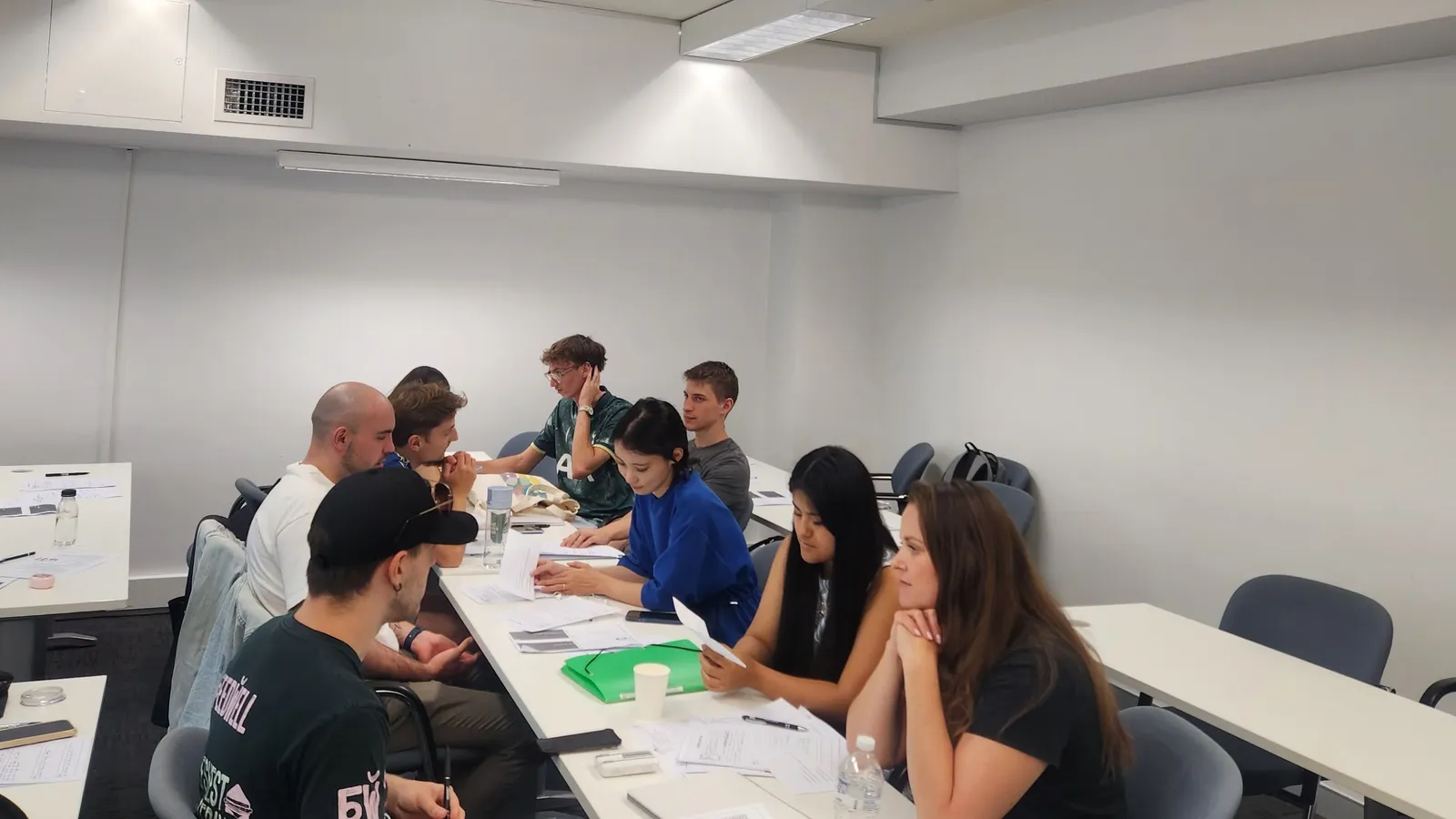
Boston Institute’s IELTS course includes full mock tests with band feedback, fortnightly assessments and speaking practice with certified trainers at Level 1 & 2, 208 Clarence Street, Sydney CBD. New intakes start every Monday.
Book a free IELTS trial class and do a mock speaking test with a trainer. You’ll get a realistic band estimate and the two or three things most likely to move it.