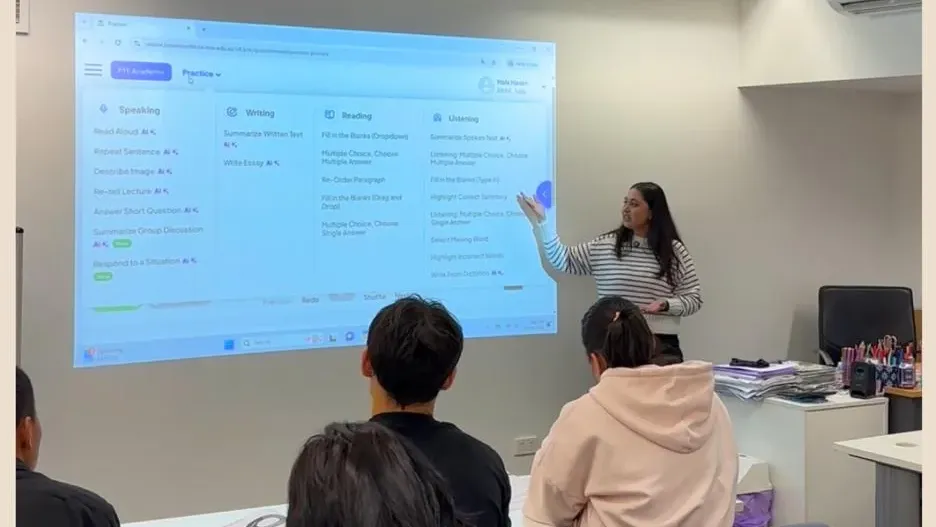
Before you can build an effective PTE study plan, you need to understand exactly what you’re preparing for. PTE Academic is a computer-based English test made up of three main parts — Speaking & Writing, Reading, and Listening — containing around 20 different task types, each contributing to your overall and section scores in specific ways. Many students start preparing without fully understanding this structure, which leads to wasted study time on the wrong tasks. This guide breaks down the complete PTE Academic exam structure for 2025, exactly as Boston Institute teaches it to every student who walks through our Sydney CBD campus.
PTE Academic at a Glance
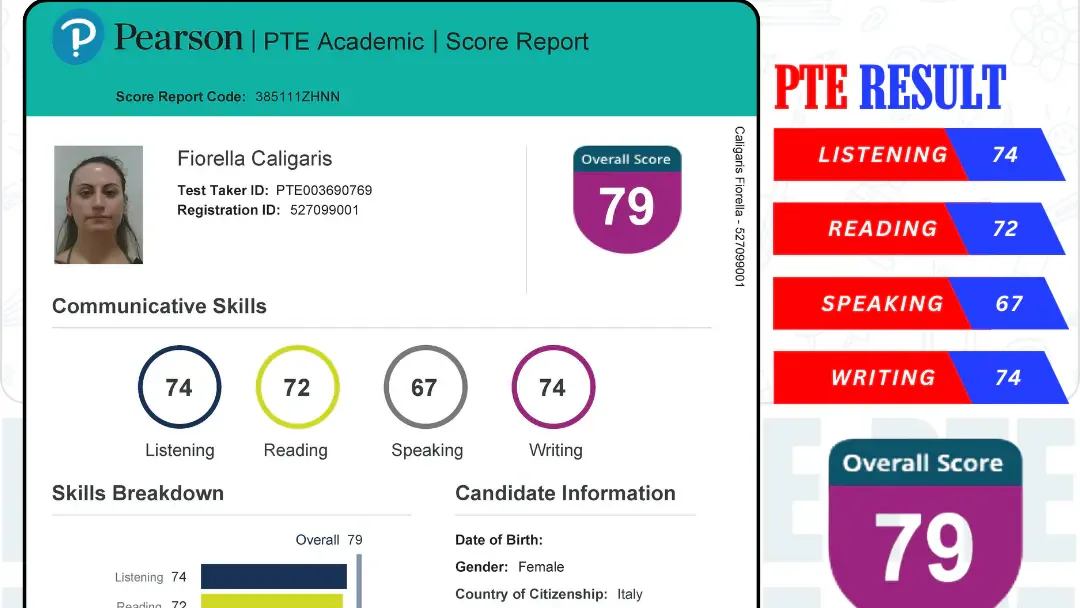
PTE Academic runs for approximately two hours, delivered entirely on a computer at a certified test centre, with your Speaking responses recorded via headset microphone. The exam is divided into three timed parts, and unlike some other English tests, PTE combines Speaking and Writing into a single opening section. Your final score report includes an Overall Score out of 90, four Communicative Skill scores (Speaking, Writing, Reading, Listening), and additional Enabling Skill scores that break down grammar, vocabulary, pronunciation, and more.
Part One: Speaking & Writing (Approximately 54–67 Minutes)
This is the longest section of the exam and the one that most influences your overall score, because several Speaking tasks also feed into your Reading and Listening scores.
Personal Introduction (unscored, 1 minute) A short recorded introduction sent to the institutions you nominate — this doesn’t count toward your score but sets your tone for the exam.
Read Aloud You read a short text aloud after a brief preparation period. This task scores Speaking, Reading, and pronunciation simultaneously, making it one of the highest-value tasks in the entire exam.
Repeat Sentence You hear a sentence once and repeat it exactly. This task contributes to Speaking and Listening scores together.
Describe Image You describe a graph, chart, map, or picture within 40 seconds. This feeds into Speaking and, indirectly, your broader fluency assessment.
Re-tell Lecture You listen to a short academic lecture, then summarise it verbally. This task scores Speaking and Listening together and rewards structured note-taking.
Answer Short Question A quick, single-word or short-phrase response to a simple question — low time pressure, but still scored for pronunciation and fluency.
Summarize Written Text You read a passage and write one summary sentence between 5 and 75 words. This scores Writing and Reading together.
Essay A 200–300 word argumentative or discursive essay written within 20 minutes, scoring Writing specifically, including grammar, vocabulary, and structure.
Part Two: Reading (Approximately 29–30 Minutes)
Reading & Writing: Fill in the Blanks You drag and drop the correct word into gaps within a passage, testing vocabulary and grammar in context.
Multiple Choice, Choose Single Answer Standard comprehension questions with one correct answer, requiring careful, targeted scanning under time pressure.
Re-order Paragraphs You arrange jumbled text boxes into the correct logical order — one of the more challenging task types, rewarding students who identify topic sentences and pronoun references quickly.
Reading: Fill in the Blanks Similar to the Writing version, but without a word bank — you select answers from a dropdown list based purely on grammatical and contextual fit.
Multiple Choice, Choose Multiple Answers Comprehension questions with more than one correct answer, penalised for incorrect selections, which rewards careful reading over guessing.
Part Three: Listening (Approximately 30–43 Minutes)
Summarize Spoken Text You listen to a short lecture or talk and write a 50–70 word summary — one of the most heavily weighted Listening tasks.
Multiple Choice, Multiple Answers (Listening) Standard comprehension with several correct answers penalised for wrong selections.
Fill in the Blanks (Listening) You type missing words into a transcript while listening — this task tests spelling accuracy as much as comprehension.
Highlight Correct Summary You select which of several written summaries best matches the audio you just heard.
Multiple Choice, Choose Single Answer (Listening) A shorter comprehension task with only one correct answer among the options.
Select Missing Word The audio cuts off before the final word, and you select the word that logically completes the sentence.
Highlight Incorrect Words You follow a transcript on screen while listening and click any word that differs from what’s actually spoken — a pure concentration and reading-speed task.
Write from Dictation You hear a short sentence once and type it exactly — testing listening accuracy, spelling, and grammar together.
How the Scoring Actually Works
PTE Academic’s AI scoring model evaluates content, pronunciation, oral fluency (for Speaking), and grammar, vocabulary, spelling, and written discourse (for Writing) using a partial-credit system for most tasks. This means an imperfect answer can still earn significant points — a crucial fact many students don’t realise, and one that removes unnecessary exam-day panic when a single task doesn’t go perfectly.
Because many task types contribute to more than one Communicative Skill score simultaneously, a small number of “high-value” tasks — Read Aloud, Repeat Sentence, Describe Image, Re-tell Lecture, Summarize Written Text, and Summarize Spoken Text — disproportionately influence your overall result. Boston Institute’s PTE coaching is built around this exact insight, prioritising these task types early in every student’s study plan.
What Changed in Recent PTE Updates
Pearson periodically updates PTE Academic’s marking criteria and, occasionally, its task formats — most recently affecting Speaking scoring weightings. Staying current with these changes matters, because study strategies built around outdated scoring rules can actively work against you on exam day. Boston Institute’s PTE materials and mock tests are updated in line with the latest official marking criteria, so students always train against the current version of the exam, not an outdated one.
Why Understanding Exam Structure Improves Your Score
Students who understand the exam structure in detail before they start studying make far more efficient use of their preparation time. Instead of practising every task type equally, they can prioritise the highest-value tasks, allocate study time proportionally, and walk into the test centre with zero surprises about pacing or format — a major confidence advantage on exam day.
How Boston Institute Prepares You for the Real Exam Structure
Boston Institute’s PTE Academic Preparation course (CRICOS Code 119103E) is delivered in a genuine computer-based exam simulation environment at our Sydney CBD campus, so students train under conditions that exactly replicate test-day format and timing. Every mock test is AI-scored using current official marking criteria, and personalised 1-on-1 coaching each week targets the specific task types where each student needs the most improvement.
Frequently Asked Questions
How many sections does the PTE Academic exam have? PTE Academic has three main timed sections: Speaking & Writing, Reading, and Listening, containing around 20 individual task types across roughly two hours of testing.
How long is the PTE Academic exam? The full PTE Academic exam takes approximately two hours, delivered in one sitting at a certified computer-based test centre.
Which PTE task types score more than one skill at once? Tasks like Read Aloud, Repeat Sentence, Re-tell Lecture, and Summarize Written Text contribute to more than one Communicative Skill score simultaneously, making them high-value tasks to prioritise in preparation.
Does PTE Academic use partial credit scoring? Yes. Most PTE task types use a partial-credit scoring model, meaning an imperfect answer can still earn meaningful points rather than scoring zero.
Is PTE Academic entirely computer-based? Yes. PTE Academic is delivered entirely on a computer at a certified test centre, with Speaking responses recorded via headset microphone and typed responses for Writing and Listening tasks.
What is the hardest section of PTE Academic? Students most commonly find Re-order Paragraphs (Reading) and Re-tell Lecture (Speaking) the most challenging, due to the structural and memory demands of each task.
How many task types are in the PTE Academic exam? PTE Academic includes around 20 distinct task types spread across its three sections, each testing specific combinations of the four Communicative Skills.
Has the PTE Academic exam structure changed recently? Pearson periodically updates PTE Academic’s marking criteria and occasionally adjusts task formats. Boston Institute updates its course materials in line with the latest official changes to keep student preparation current.
What score range does PTE Academic use? PTE Academic scores range from 10 to 90 for the Overall Score and each Communicative Skill score, with Enabling Skills (grammar, vocabulary, pronunciation, and more) scored separately.
Does Boston Institute simulate the real PTE exam structure in class? Yes. Boston Institute’s Sydney CBD campus includes a dedicated computer-based exam simulation environment, allowing students to practise under conditions that closely match real test-day format and timing.
Master the PTE Structure with Boston Institute
Understanding the PTE Academic exam structure is the first step — mastering it under real exam conditions is what actually improves your score. Boston Institute’s PTE Academic Preparation course (CRICOS 119103E) combines computer-based exam simulations, AI-scored mock tests, and personalised coaching at our Sydney CBD campus. New intakes start every Monday. Apply online at bostoninstitute.nsw.edu.au/apply or call 02 9836 6427.