A PTE mock test is useful for what it tells you, not for the practice alone. Every Boston Institute PTE student gets platform access with 10 full mock tests, 5 sectional tests for each skill (Speaking, Writing, Reading and Listening), thousands of practice questions and progress tracking. Together they show which task types are costing you points and whether you’re ready to book the real test.
Most people treat a mock test like a scoreboard. They sit it, look at the number, feel good or bad, and do more practice the same way. That’s the slowest way to improve.
Here’s how we use mocks at our Sydney CBD campus, what the platform includes, and what the results usually reveal.
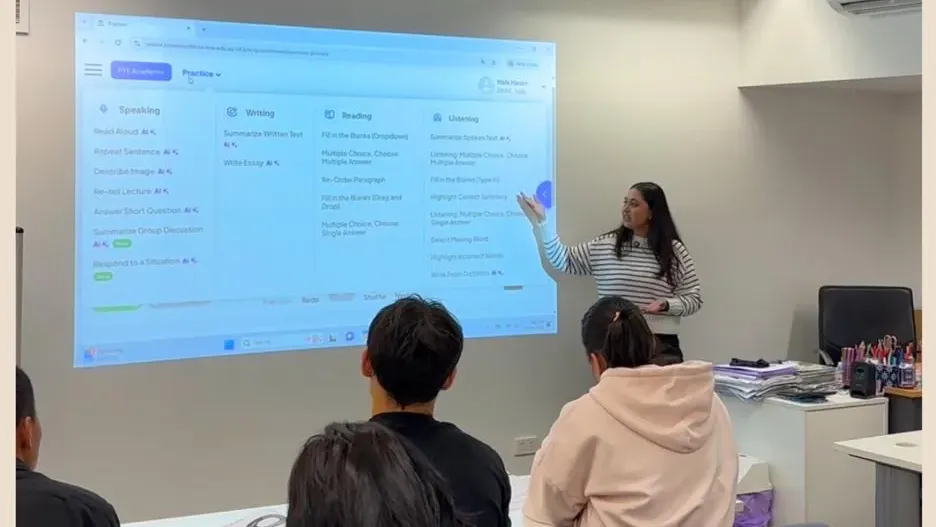
What’s included in the Boston Institute PTE practice platform
Every enrolled PTE student gets access. You can use it at the campus or from home on any device, 24/7.
| Feature | What it’s for |
|---|---|
| 10 full mock tests | Timed, full-length tests with detailed feedback and a personalised study plan after each one |
| 5 sectional tests per skill | Short tests for Speaking, Writing, Reading and Listening, so you can check one skill without sitting a full 2-hour mock |
| Thousands of practice questions | Task-by-task practice across every PTE module |
| Speaking and writing templates | High-scoring structures for tasks like Describe Image, Retell Lecture and the essay, with guidance on adapting them |
| PTE collocation lists | Common word partnerships that come up in Reading & Writing Fill in the Blanks |
| Grammar, vocabulary and linking-word guides | Accuracy support for Writing and Speaking |
| Study plans that update with your results | Your plan changes as your scores change |
| Progress tracking | A record of your scores by skill and task type, over time |
Enrolled students log in at the PTE portal. Not enrolled yet? You can register for a free PTE or IELTS mock test and see how you’re tracking first.
Why 10 mocks, and not 30?
Because a mock test is expensive in the one thing you can’t buy more of: focused hours.
A full PTE Academic test takes about two hours. If you sit a full mock every day, you spend most of your study time testing and very little fixing. We see this a lot with students who’ve prepared alone. They’ve done 25 free mocks online, their score hasn’t moved in a month, and they can’t work out why.
Ten full mocks spread across a course gives you a rhythm:
- 1Mock 1: diagnostic. Where are you, skill by skill?
- 2Mocks 2–7: checkpoints. Roughly one every week or so, after a block of targeted practice.
- 3Mocks 8–10: readiness checks. Are you consistently above your target in every skill, with a margin?
The sectional tests fill the gaps between full mocks. If your Reading was the problem last week, a 30-minute Reading sectional test tells you whether this week’s practice worked. You don’t need to sit Speaking and Listening again to find out.
What mock test results usually reveal
Your overall score is the least useful number on a mock report. Three other things matter more.
1The one task type dragging a whole skill down
PTE skills are built from several task types, and some carry more weight than others. A student might score well across most Listening tasks and still land 10 points under target because of Write from Dictation. Progress tracking by task type makes that visible. Without it, you’d keep doing general listening practice and wonder why nothing changes.
2Cross-skill tasks you’re under-using
Several PTE tasks feed more than one skill score. Read Aloud counts towards Speaking and Reading. Repeat Sentence counts towards Speaking and Listening. Write from Dictation counts towards Listening and Writing. When a student’s mock report shows two skills sitting just below target, these shared tasks are often the fastest fix. Our PTE speaking tips go through Read Aloud and Repeat Sentence in detail.
3Whether your “good” score is a fluke
One strong mock doesn’t mean you’re ready. Three in a row above target does. We ask students to see a consistent margin before booking the real test, usually a few points above each threshold. Test-day nerves cost most people a few points, and the real test is less forgiving than a mock you took at home with a cup of tea.
The visa scores your mocks should be measured against
Here’s a problem we see every week. A student aims their mocks at “65” or “79”, because that’s what they heard for PR. But Home Affairs changed the PTE scores for visa purposes on 7 August 2025, and the new thresholds are different for each skill.
For example, superior English (20 points in the skilled migration points test) now needs Listening 69, Reading 70, Writing 85 and Speaking 88 for tests taken on or after that date (Pearson’s summary). If your mocks show 79 in every skill, you’re at proficient level, not superior.
Our platform lets you track each skill against your actual visa threshold. For the full breakdown, see our guide to English points for the 189, 190 and 491 visas, or our posts on the 482 and 485 visas.
Collocation lists: small tool, big difference in Reading
Reading & Writing Fill in the Blanks is one of the highest-value tasks in PTE Reading. It’s also where strong readers lose marks unexpectedly.
The reason is collocation. The task often tests which word naturally goes with another, not which word is grammatically possible. “Conduct research” is right. “Make research” isn’t, even though a learner might understand both. Our PTE collocation lists group the word partnerships that come up often, so you learn them as pairs rather than as isolated vocabulary.
Twenty minutes a day with a collocation list, then straight into a set of fill-in-the-blanks questions, is one of the simplest routines we recommend for Reading.
Templates: useful, but not the whole answer
The platform includes speaking and writing templates for tasks such as Describe Image, Retell Lecture and the essay. Templates help you organise your answer under time pressure and avoid freezing.
But be careful. Pearson updated how PTE is scored in 2025, and heavily memorised, generic responses don’t score the way they once did. (Our post on the PTE marking changes explains more.) We teach templates as a structure you fill with real content from the prompt, not a script you recite. The mock feedback will tell you quickly if your template is doing more harm than good.
Platform vs free online mocks vs Pearson’s official tests
You’ve got three main options for practice, and they’re good for different things.
| Option | Good for | Watch out for |
|---|---|---|
| Free online mocks | Getting familiar with the format | Scoring accuracy varies a lot between sites |
| Pearson’s official scored practice tests | A close reading of how Pearson scores you | They cost money, and there are only a few |
| Boston Institute platform | Structured mocks, sectional tests and tracking linked to a study plan and a trainer | Needs enrolment in a PTE course |
Our advice: use the platform (or any structured practice) for most of your preparation, and sit one Pearson official scored practice test near the end as a final check. If the two scores roughly agree, book the real thing. Pearson’s test format page is also worth reading once so the real test holds no surprises.
How a trainer uses your mock results
The platform does the scoring. A trainer does the interpreting.
After each full mock, a Boston Institute trainer reviews your report with you and turns it into a plan for the next week. For example, “your Reading is on track, but Describe Image is costing you in Speaking. Spend three sessions on it, then sit the Speaking sectional test on Friday.” That’s the part software can’t do on its own. It’s also the biggest difference between a course and studying alone with the same practice questions. (We wrote more about that in English language school vs self-study for PTE.)
Frequently asked questions
How many mock tests do Boston Institute PTE students get?
Every PTE student gets access to 10 full mock tests, plus 5 sectional tests for each skill (Speaking, Writing, Reading and Listening), through our online practice platform.
Are PTE mock tests accurate?
They’re a good guide, but no mock is a perfect prediction. The most reliable signal is consistency: several mocks in a row above your target in every skill. Pearson’s official scored practice tests are the closest match to the real scoring.
How often should I take a PTE mock test?
For most students, about one full mock a week is enough, with sectional tests in between to check individual skills. Taking a full mock every day leaves too little time to fix the problems it finds.
What is a PTE sectional test?
A sectional test covers just one skill, such as Reading or Speaking. It lets you check whether your practice on that skill is working without sitting a full two-hour mock.
Can I use the practice platform from home?
Yes. Enrolled students can use the platform on any device, 24/7, whether they attend classes at our Sydney CBD campus or study online.
Can I try a mock test before enrolling?
Yes. You can register for a free PTE or IELTS mock test on our website, or book a free demo class and do a diagnostic with a trainer.
See your gaps before you book the real test
Boston Institute runs PTE preparation at Level 1 & 2, 208 Clarence Street, Sydney CBD, two minutes from Town Hall Station. New intakes start every Monday, with weekday and weekend classes, and every student gets full platform access.
Book a free PTE demo class or try our PTE score predictor to see where you’re starting from.