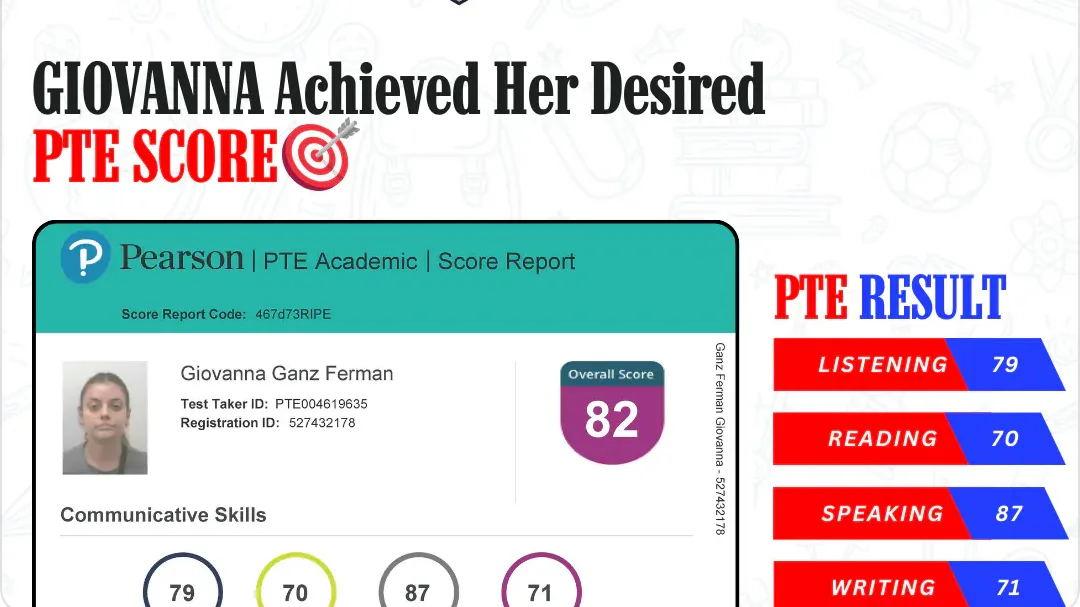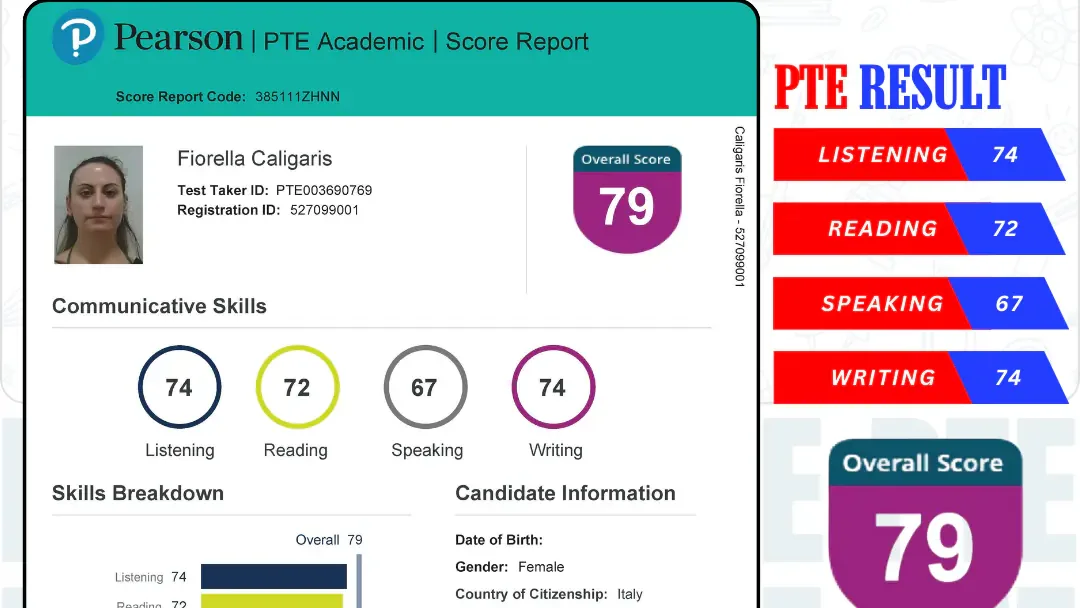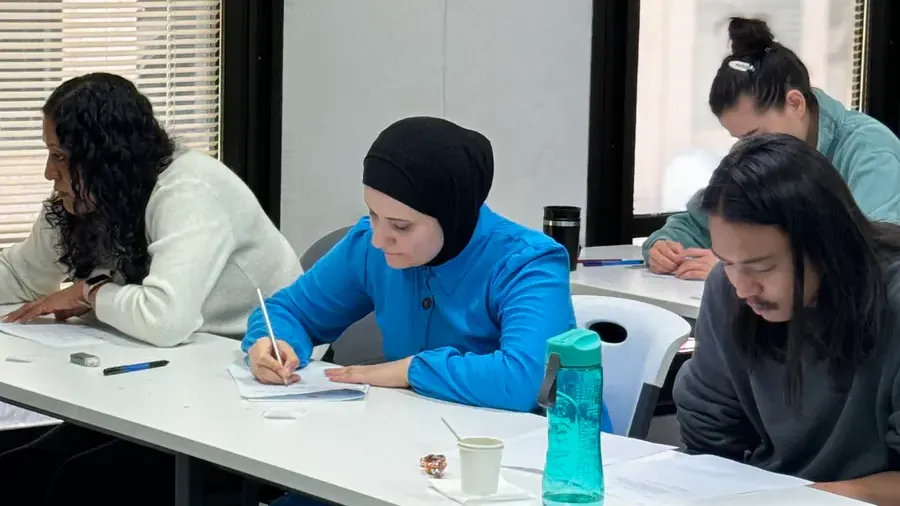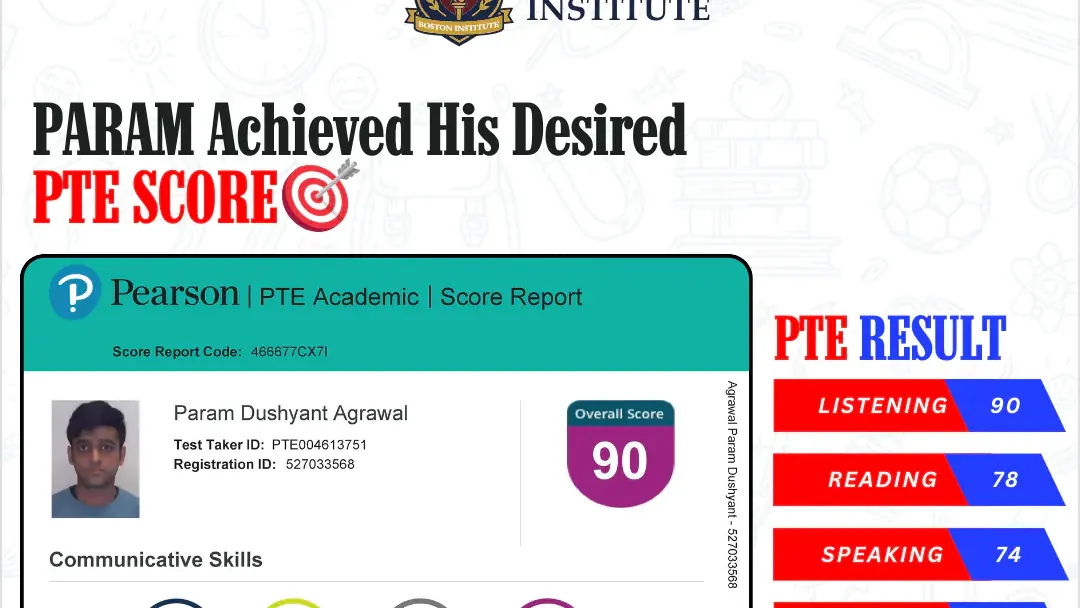
PTE Academic is a computer-based English test of about two hours, covering Speaking & Writing, Reading and Listening, with scores from 10 to 90. Results usually arrive within about two days. It’s accepted for all Australian visas. For tests taken on or after 7 August 2025, visa score levels are set per skill. Competent English, for example, is Listening 47, Reading 48, Writing 51 and Speaking 54.
This is our hub guide to PTE. It covers everything a candidate in Australia needs, from the format to the study plan, and links out to our deeper articles on each topic. Bookmark it.
In this guide: 1. What PTE Academic is (and who it suits) 2. Test format, including the 2025 changes 3. How PTE scoring works 4. PTE scores for Australian visas 5. PTE vs IELTS 6. Booking the test: cost, centres and results 7. How long preparation takes 8. Study plans by target score 9. Practice and mock tests 10. Common mistakes 11. Studying PTE with a coach in Sydney
1. What is PTE Academic?
PTE Academic (Pearson Test of English Academic) is an English proficiency test run by Pearson. The whole test is taken on a computer at a test centre, including speaking, which you record into a headset instead of speaking to an examiner.
It’s accepted by the Department of Home Affairs for every visa that needs English evidence, and by Australian universities and many professional registration bodies.
PTE tends to suit people who:
- want results quickly (typically within two days)
- type faster than they handwrite
- prefer speaking to a microphone over a face-to-face interview
- are comfortable with a strict, predictable format
It suits some people less well, like those who freeze when a timer is running or who find it hard to speak without a listener in front of them. If that’s you, read the PTE vs IELTS section below before booking.
2. PTE Academic test format (2026)
The test takes about two hours and has three parts. Pearson made changes for tests taken after 7 August 2025. There are two new question types, and some responses are now part-scored by humans as well as AI. Pronunciation and fluency are still scored by AI only (Pearson: PTE updates 2025).
Part 1: Speaking & Writing
| Task | What you do |
|---|---|
| Personal Introduction | Introduce yourself (not scored) |
| Read Aloud | Read a short text aloud |
| Repeat Sentence | Repeat a sentence you hear |
| Describe Image | Describe a graph, chart, map or picture |
| Re-tell Lecture | Retell a short lecture in your own words |
| Answer Short Question | Answer a simple question in one or a few words |
| Summarize Group Discussion (new, 2025) | Listen to a discussion of about 3 minutes, then summarise it aloud |
| Respond to a Situation (new, 2025) | Read and hear a scenario, then respond as you would in real life |
| Summarize Written Text | Summarise a passage in one sentence |
| Write Essay | Write an argumentative essay |
Part 2: Reading
| Task | What you do |
|---|---|
| Reading & Writing: Fill in the Blanks | Choose the right word for each gap from drop-down lists |
| Multiple Choice, Multiple Answers | Choose all correct answers |
| Re-order Paragraphs | Put jumbled text boxes in the right order |
| Reading: Fill in the Blanks | Drag words into gaps |
| Multiple Choice, Single Answer | Choose one correct answer |
Part 3: Listening
| Task | What you do |
|---|---|
| Summarize Spoken Text | Write a summary of a short recording |
| Multiple Choice, Multiple Answers | Choose all correct answers |
| Fill in the Blanks | Type missing words into a transcript |
| Highlight Correct Summary | Choose the best summary |
| Multiple Choice, Single Answer | Choose one correct answer |
| Select Missing Word | Choose the word that ends the recording |
| Highlight Incorrect Words | Spot words in a transcript that differ from the audio |
| Write from Dictation | Type a sentence exactly as you hear it |
Pearson’s test format page has official timings and examples. For a deeper walkthrough of each section, see our PTE Academic exam structure guide and our posts on the PTE exam changes and the updated marking criteria.
3. How PTE scoring works
You get an overall score and four skill scores (Listening, Reading, Speaking and Writing), each from 10 to 90.
Two features of PTE scoring surprise most new candidates.
Many tasks count towards two skills. This is called integrated scoring. Read Aloud contributes to both Speaking and Reading. Repeat Sentence contributes to Speaking and Listening. Write from Dictation contributes to Listening and Writing. Summarize Spoken Text contributes to Listening and Writing. Because of this, a few tasks carry a lot of weight, and good preparation focuses on them.
Speaking is judged partly on how you speak, not just what you say. Oral fluency (smooth, steady delivery without long pauses or restarts) and pronunciation (clear, understandable speech) are scored by AI. A candidate with perfect grammar who hesitates and restarts will lose marks. Our top 10 PTE speaking tips cover how to handle this.
Some tasks are negatively marked. In Multiple Choice, Multiple Answers, a wrong choice loses a point, so guessing extra answers can cost you. Only select options you’re confident about.
4. PTE scores for Australian visas
This is the section to read twice. Home Affairs changed the PTE scores it accepts for tests taken on or after 7 August 2025. The old “50 / 65 / 79 in each skill” rule of thumb applies only to tests taken on or before 6 August 2025.
| English level | Used for (examples) | PTE, tests on or after 7 Aug 2025 | PTE, tests on or before 6 Aug 2025 |
|---|---|---|---|
| Functional | 407 Training visa, some family visas | Overall 24 | Overall 30 |
| Vocational | 482 Skills in Demand visa | L 33, R 36, W 29, S 24 | 36 each |
| Competent | 189/190/491 minimum, 186 visa | L 47, R 48, W 51, S 54 | 50 each |
| Proficient | +10 points in the points test | L 58, R 59, W 69, S 76 | 65 each |
| Superior | +20 points in the points test | L 69, R 70, W 85, S 88 | 79 each |
Sources: Home Affairs, English language and Pearson’s summary of the new DHA scores.
Results from tests taken on or before 6 August 2025 can still be used until 6 August 2028, provided they also meet your visa’s own timing rules.
Look at the Speaking and Writing columns for proficient and superior. They’re much higher than Listening and Reading. For most PR-track candidates, those two skills now decide whether you get 10 or 20 points.
Our visa-specific guides go into each one:
- English points for the 189, 190 and 491 visas
- 482 Skills in Demand visa English requirements
- 485 Graduate visa English requirements
- 407 Training visa English requirements
Or see every visa on one page in our Australian visa English guide.
5. PTE vs IELTS: which should you take?
Both are accepted for every Australian visa. Neither is objectively “easier”. The better test is the one that suits your strengths.
| PTE Academic | IELTS | |
|---|---|---|
| Format | Fully computer-based | Computer or paper; Speaking is a face-to-face interview |
| Results | Typically within about 2 days | Computer-delivered typically about 1 day; paper takes longer |
| Speaking | Recorded into a microphone, scored by AI | Conversation with an examiner |
| Scoring style | Integrated (tasks feed several skills) | Each skill scored separately |
| Visa scores changed in 2025? | Yes, new per-skill thresholds | No |
Choose PTE if you’re comfortable on a computer, want fast results, and your speaking is fluent even if not perfectly accurate. Choose IELTS if you communicate better with a person in front of you and your writing holds up under a human examiner.
For more detail, read IELTS vs PTE in Australia and our PTE to IELTS score comparison. Our complete IELTS guide covers the other side.
6. Booking the test: cost, centres and results
- Cost: the commonly listed fee in Australia is about AUD 490, but confirm the price for your centre when you book, because it can change.
- Where: PTE test centres operate in all major Australian cities, including several in Sydney.
- Results: typically within about two days, through your myPTE account.
- Rescheduling: usually free if you change more than 14 days before your test. Check Pearson’s current policy when you book.
- Validity: for visa purposes, the test must be within the validity window for your visa, often 3 years (12 months for the 485).
Book through Pearson’s official site. Our step-by-step guide on how to book the PTE test in Australia walks you through it.
One practical tip: don’t book the real test until your mock scores clear every skill threshold with a margin. Test-day nerves usually cost a few points.
7. How long does PTE preparation take?
It depends on the gap between where you are and where you need to be, not on a fixed number of weeks.
| Starting point | Target | Typical preparation |
|---|---|---|
| Strong everyday English, first attempt | Vocational (482) | 1–3 weeks |
| Upper-intermediate English | Competent | 3–6 weeks |
| Already at competent | Proficient | 4–8 weeks |
| Already at proficient | Superior | 6–12 weeks or more |
These are typical ranges, not promises. Speaking fluency and writing accuracy usually take longest to move. Our full article on how long it takes to prepare for PTE goes into detail.
If your everyday English is below upper-intermediate, PTE preparation alone is a slow path. Build a base with General English first. Our guide to General English vs IELTS: which first? applies to PTE as well.
8. Study plans by target score
Targeting competent English
Focus on the high-value integrated tasks: Read Aloud, Repeat Sentence, Write from Dictation and Reading & Writing Fill in the Blanks. Practise every day in short sessions. Most competent-level candidates lose marks through inconsistency, not a lack of English. Our guide to getting 65 in PTE is still useful for task technique.
Targeting proficient English
Your priorities are Speaking 76 and Writing 69. Record yourself daily. Work on smooth delivery without restarts. For writing, move beyond templates to essays that respond to the actual prompt with accurate grammar.
Targeting superior English
Speaking 88 and Writing 85 are very high bars. You need near-native fluency under time pressure and highly accurate written English. Many candidates at this level benefit from one-to-one feedback. It’s also worth running a diagnostic in IELTS, where superior English is 8 in each band. For some candidates that’s a more achievable route to 20 points. Our guide to scoring 79 in PTE covers advanced task strategy, but for new tests, remember the split thresholds above.
A sample 4-week timetable (competent to proficient)
For a working candidate with about 90 minutes a day on weekdays and a longer session at the weekend:
| Week | Weekdays (about 90 min) | Weekend |
|---|---|---|
| 1 | Diagnostic mock; daily Read Aloud and Repeat Sentence recordings; 20 Write from Dictation | Review the mock by task type; pick your two weakest tasks |
| 2 | Describe Image and Re-tell Lecture fluency drills; one essay every two days with feedback | Speaking sectional test; rewrite your two weakest essays |
| 3 | Reading & Writing Fill in the Blanks with collocation lists; Summarize Written Text accuracy | Full timed mock |
| 4 | Targeted work on whichever skill is furthest below its threshold | Second full mock; book the test if every skill clears its target with a margin |
Task priority list
If time is short, this is roughly the order we’d put your practice hours in:
- 1Read Aloud and Repeat Sentence. Both are heavily weighted in Speaking and feed Reading and Listening too.
- 2Write from Dictation. Short, high-value, and it counts for Listening and Writing.
- 3Reading & Writing Fill in the Blanks. The biggest single contributor to Reading for most candidates.
- 4Describe Image and Re-tell Lecture. Fluency and structure matter more than covering every detail.
- 5Write Essay and Summarize Written Text. Grammar accuracy matters more than impressive vocabulary.
- 6The two newer tasks (Summarize Group Discussion, Respond to a Situation). Practise them so they don’t surprise you, but don’t let them take over your study plan.
Everything else gets steady, lighter practice. This isn’t a rule. If your diagnostic shows a particular task is costing you heavily, move it up.
9. Practice and mock tests
Practice is essential, but the way you use it matters more than the quantity.
- Use full mock tests as checkpoints, not daily practice. About one a week is enough for most candidates.
- Use sectional tests to check one skill after focused work.
- Track scores by task type, not just overall, so you can see exactly what’s costing you points.
- Sit one official scored practice test from Pearson near the end as a final check.
Boston Institute students get platform access with 10 full mock tests and 5 sectional tests per skill. Our article on what PTE mock tests reveal explains how to read your results. Not enrolled? Register for a free PTE mock test, or use our PTE score predictor to estimate your starting point.
10. Common PTE mistakes
- 1Using old score charts. “65 each” and “79 each” only apply to tests taken before 7 August 2025.
- 2Restarting sentences in Speaking. Fluency drops sharply. Keep going even after a small mistake.
- 3Memorised templates with no real content. With part-human scoring since 2025, generic answers are riskier.
- 4Guessing in Multiple Choice, Multiple Answers. Wrong answers are penalised.
- 5Misspelling in Write from Dictation. Every word counts, and it affects two skills.
- 6Booking too early. Wait until your mocks clear every threshold consistently.
11. Studying PTE with a coach in Sydney
You can prepare for PTE on your own. Many people do. A course helps most when your score has stalled, when you’re chasing proficient or superior, or when a visa deadline doesn’t leave room for trial and error. Our post on English school vs self-study for PTE weighs up both options, and how to choose a PTE course in Australia lists what to look for.
Boston Institute’s PTE preparation course runs from our Sydney CBD campus at Level 1 & 2, 208 Clarence Street, two minutes from Town Hall Station. It includes:
- computer-based classes that simulate the real test
- weekly mock tests with trainer feedback
- 24/7 access to our online practice platform
- targeted plans for each visa score level
- score guarantee programmes on selected courses (conditions apply)
- new intakes every Monday, with weekday and weekend options
Boston Institute is CRICOS-registered (provider code 04068C; PTE course code 119103E), so eligible students can also study PTE preparation on a student visa.
Frequently asked questions
How long is the PTE Academic test?
About two hours, in three parts: Speaking & Writing, Reading and Listening.
What are the new PTE question types from 2025?
For tests taken after 7 August 2025, Pearson added Summarize Group Discussion and Respond to a Situation to the Speaking & Writing part.
What PTE score do I need for Australian PR?
You need at least competent English to apply for the 189, 190 or 491 visas. For PTE tests taken on or after 7 August 2025, that’s Listening 47, Reading 48, Writing 51 and Speaking 54. Proficient English (10 points) and superior English (20 points) need higher scores in each skill.
How much does the PTE test cost in Australia?
The commonly listed fee is about AUD 490. Check the current price for your test centre when you book, as fees can change.
How quickly do PTE results come out?
Typically within about two days, through your myPTE account.
Is PTE easier than IELTS?
Neither is easier for everyone. PTE suits candidates who are comfortable on a computer and speak fluently. IELTS suits those who do better speaking face to face with an examiner.
Is PTE scored by computer or humans?
Mostly by AI. Since August 2025, some responses are part-scored by humans as well, but pronunciation and fluency are still scored only by AI.
Can I study PTE preparation on a student visa?
Yes, at a CRICOS-registered provider. Boston Institute’s PTE course (CRICOS course code 119103E) can be studied on a student visa.
Start your PTE preparation
Every PTE plan starts with knowing your gap. Book a free PTE trial class, including a sample mock test and a strategy session, or apply now. Applying is free and new classes start every Monday.